Slope IO
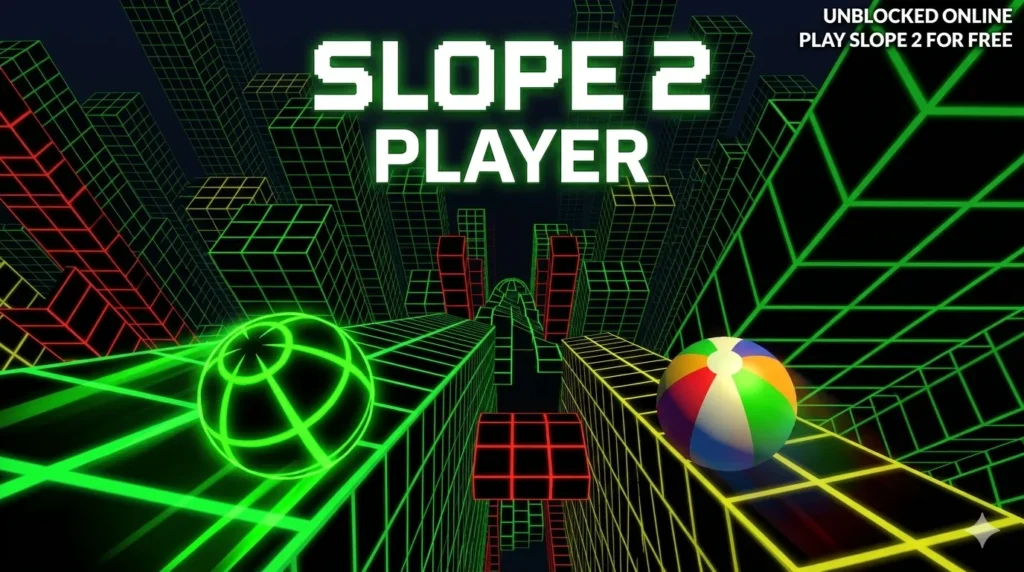
Slope IO is a fast-paced 3D endless-running game built around one simple challenge: keep a rolling ball on a constantly changing slope for as long as possible. The ball moves automatically, while the player controls its direction, avoids dangerous obstacles, and reacts to increasingly difficult sections of the track.
The appeal comes from its simple controls and demanding gameplay. There are no complicated inventories, upgrades, traditional checkpoints, or elaborate controls to learn. Instead, success depends on reflexes, timing, concentration, precision, anticipation, and controlled movement.
The neon-style environment, sharp turns, sudden drops, narrow paths, moving platforms, gaps, and red obstacles make every run a test of reaction speed.
What Is Slope IO?
Slope IO is an endless 3D running experience in which a ball continuously rolls down a winding and increasingly challenging track. The objective is straightforward:
Control the ball → stay on the track → avoid obstacles → survive longer → travel farther → achieve a higher score.
The game does not depend on traditional level progression. Instead, the challenge develops during the run as speed increases and the terrain becomes more unpredictable.
Its minimalist design makes the gameplay easy to understand, while the increasing pace creates a much harder experience over time.
Core Gameplay Features
The four competitor sources consistently focus on several important characteristics of the game:
| Feature | How It Affects Gameplay |
|---|---|
| 3D environment | Creates a fast-moving visual perspective |
| Endless track | Runs continue without traditional levels |
| Automatic movement | The ball continuously moves forward |
| Increasing speed | Makes later sections harder to control |
| Red obstacles | Contact can immediately end a run |
| Narrow paths | Require accurate steering |
| Gaps | Falling from the track ends the attempt |
| Sharp turns | Demand quick directional adjustments |
| Moving platforms | Add additional timing challenges |
| Procedural/randomized terrain | Makes the route less predictable |
| Neon visuals | Gives the game its recognizable visual identity |
| Distance-based scoring | Traveling farther results in a higher score |
| No power-ups | Progress depends on player skill |
| No checkpoints | A mistake can end the current attempt |
How Slope IO Works
The ball moves forward automatically, so the player’s primary responsibility is steering.
The basic gameplay cycle is:
- The ball begins moving down the slope.
- The player steers left or right.
- The track introduces turns, drops, gaps, and obstacles.
- Speed gradually increases.
- The player must anticipate upcoming sections.
- Falling or hitting a dangerous red obstacle ends the run.
- Surviving farther produces a higher score.
This creates a distance-versus-survival challenge rather than a conventional level-based game.
Slope IO Controls
One of the strongest advantages of the game is its simple control system.
| Control | Action |
|---|---|
| Left Arrow ← | Move or roll left |
| Right Arrow → | Move or roll right |
| A | Alternative left control |
| D | Alternative right control |
The sources describe 2 primary directional keys, with A/D providing an alternative keyboard scheme.
There is no dedicated jump control or manual brake described in the competitor content. The ball’s forward momentum is continuous, so players must manage direction rather than stopping the run.
Why Does Slope IO Become Difficult?
The difficulty comes from several mechanics working together rather than from complicated controls.
Increasing Speed
Speed is one of the defining features. According to the Slopeio.org content, the environment starts becoming noticeably faster and more difficult after approximately 15–20 seconds.
As the ball gains momentum, there is less time to react to upcoming turns, gaps, and obstacles.
Narrow Tracks
Narrow sections leave less room for correction. A small steering mistake can send the ball off the track.
Sharp Turns and Sudden Drops
The route can change direction quickly, requiring players to react before reaching the turn rather than waiting until the last moment.
Red Obstacles
Red blocks are among the most important hazards mentioned across the competitor content. Hitting them can immediately end the run.
Gaps and Falling Hazards
The track can contain gaps and sections where the player must keep the ball aligned with the available surface. Falling from the track ends the attempt.
Procedural or Randomized Paths
The terrain is described as procedural, randomized, or unpredictable across the supplied competitor sources. This reduces reliance on simply memorizing a fixed route.
How Does Scoring Work?
The scoring system is centered on distance.
More distance traveled = higher score.
There is no traditional upgrade system needed to increase the score. Instead, players improve their results by maintaining control for longer.
The competitor content includes several numerical score references:
| Number | Context |
|---|---|
| 9 | Beginner’s best score mentioned by SlopeGameAZ |
| 10 points | Early score milestone |
| 25 seconds | Approximate time associated with reaching the first 10 points |
| 60 | Milestone described as difficult during early play |
| 1 minute+ | Later survival time mentioned after repeated attempts |
| 417 | Record referenced in a Slopeio.org article title |
| Hundreds | Number of attempts discussed in relation to replayability |
The 417 figure should be understood as a record reference from the competitor’s article title, rather than as an independently verified universal world record.
How Long Does a Slope IO Run Last?
There is no fixed time limit described in the supplied competitor content.
Instead, a run ends when the player loses control, hits a dangerous obstacle, or falls from the track.
One competitor’s personal experience gives a useful progression:
- Initial survival: 25 seconds
- Early best score: 9
- First 10 points: approximately 25 seconds
- Later survival: 1 minute+
- Improvement: achieved after hundreds of attempts
These figures illustrate how practice can improve control, but they are not fixed game limits.
7 Main Difficulty Factors
SlopeGame-2.io identifies 7 major factors that contribute to the challenge:
- Increasing acceleration
- Narrow paths
- Procedural slopes
- Red obstacles
- Audio cues
- Speed and angle changes
- Leaderboards
Together, these elements turn a simple left-right control system into a demanding reflex game.
Practical Tips for Better Runs
The competitor content provides several useful strategies for improving performance.
Steer Softly
Avoid making unnecessarily large movements. Small directional adjustments can provide better control when the ball is moving quickly.
Watch Ahead
Instead of focusing only on the ball, look farther along the track. Anticipating a turn or gap gives you more time to react.
Stay Near the Centre
When the track allows it, remaining near the centre can provide more room to respond to changes on either side.
Follow the Slope’s Rhythm
Movement should match the direction and shape of the terrain. Sudden overcorrections can be more dangerous than controlled steering.
Use Keyboard Controls
The competitor content recommends keyboard controls for precise movement rather than relying on mouse movement.
Maintain Stable Performance
Slopeio.org specifically highlights stable FPS as useful for consistent gameplay.
What Makes Slope IO Different?
The main distinction is its combination of simple controls and continuously increasing pressure.
Many conventional games give players upgrades, checkpoints, power-ups, or multiple abilities. Slope IO instead strips the experience down to movement, reaction, and survival.
| Element | Slope IO Approach |
|---|---|
| Movement | Automatic forward motion |
| Main control | Left/right steering |
| Progression | Continuous run |
| Levels | No traditional fixed levels |
| Checkpoints | None described |
| Power-ups | None |
| Upgrades | None |
| Braking | No manual brake |
| Scoring | Distance-based |
| Main skill | Reflexes and precision |
| Failure | Obstacle collision or falling |
| Competition | High scores and leaderboards |
Slope IO History and Development
The supplied SlopeGame-2.org content presents a development timeline connected with the game.
| Year | Claimed Event |
|---|---|
| 2014 | Initial launch |
| 2016 | WebGL port |
| 2018 | Mobile release |
| 2020 | “Unblocked” peak |
| 2025 | Unity 6 update |
| 2026 | V1.7 patch |
The same competitor identifies Rob Kay as the developer/lead designer and Y8 Games as the publisher. It also associates Rob Kay with Guitar Hero and Rock Band.
Another competitor, SlopeGameAZ.io, also states 2014 as the claimed release year and identifies Y8 Studios in its developer/publisher information.
Because the supplied sources use both Y8 Studios and Y8 Games, these names should be treated as the entities presented by the respective competitor pages rather than unnecessarily combining their roles.
Technology and Visual Style
The game is consistently presented as a 3D experience with a distinctive neon aesthetic.
The supplied competitor content mentions:
- 3D gameplay
- Neon graphics
- Neon-style environments
- Retro-futuristic green-and-black visuals
- WebGL
- Unity 6
- 144Hz stability
- Procedural terrain
- Physics-based movement
The 144Hz figure appears specifically in the context of the claimed 2026 V1.7 patch, which the competitor says focused partly on leaderboard security and 144Hz stability.
Who Is Slope IO For?
The detailed competitor content identifies several player types:
- High-score hunters
- Reflex specialists
- Skill purists
- Endless-runner fans
- Arcade traditionalists
- Casual competitors
- Quick-session gamers
The game particularly suits players who prefer mechanics that are easy to learn but difficult to master.
Related Slope Games and Similar Titles
The supplied sites mention several related or comparison games.
| Game | Relationship Mentioned |
|---|---|
| Slope 2 | Sequel |
| Slope 3 | Sequel |
| Slope Run | Slope variation/related game |
| Slope City | Related Slope game |
| Slope Ball | Related Slope game |
| Slope Xtreme | Related game |
| Slide Down | Related game |
| Flying Ball | Related game |
| Slope Rider | Similar game |
| Subway Surfers | Similar/comparison game |
| Jetski Race | Similar game |
| Snow Rider 3D | Similar game |
| Temple Run | Similar game |
| Tap Road Beat | Comparison based on rhythm/skill |
| Flipper Basketball | Comparison based on precision |
The comparison content suggests that Tap Road Beat focuses more heavily on rhythm, Flipper Basketball on precision, while Slope emphasizes anticipation and continuous micro-decisions.
Frequently Asked Questions
Is Slope IO an endless game?
Yes. The supplied competitor content consistently describes it as an endless runner. There are no traditional fixed levels, and the run continues until the player fails.
What are the main Slope IO controls?
The primary controls are the Left Arrow and Right Arrow keys. A and D are also provided as alternative directional controls.
Does Slope IO have power-ups?
The supplied competitor pages describe the game as having no power-ups and no upgrades. Progress is based primarily on player skill.
Does Slope IO have checkpoints?
No checkpoints are described in the competitor content. Falling or hitting a failure obstacle ends the current attempt.
How is the score calculated?
The scoring system is based on distance. The farther the ball travels before the run ends, the higher the score.
Does Slope IO have a time limit?
No fixed time limit is described. A run can continue as long as the player remains on the track and avoids failure conditions.
Why does the game become harder?
The ball gains speed, while the terrain becomes more challenging through narrow paths, sharp turns, drops, gaps, red obstacles, and changing slopes.
What is the 417 number associated with Slope?
The supplied Slopeio.org content references 417 in the title of an article about a record being broken. It is presented as a record-related figure rather than a stated universal score limit.
What release year is mentioned for Slope?
The supplied competitor pages identify 2014 as the claimed initial release year. SlopeGame-2.io additionally presents 2016, 2018, 2020, 2025, and 2026 as later development milestones.
Is Slope IO easy for beginners?
The controls are easy to understand because they primarily require left and right movement. However, the game becomes progressively harder as speed increases, meaning mastering it requires practice and precise reactions.
Final Takeaway
Slope IO succeeds by keeping its concept simple: control a rolling ball, stay on the track, avoid hazards, and travel as far as possible. Its 3D neon presentation, increasing speed, procedural terrain, narrow paths, red obstacles, and distance-based scoring create a challenging endless-running experience without complicated controls or upgrade systems.
The numerical details from the supplied competitors also show how the challenge develops: difficulty can noticeably increase after around 15–20 seconds, an early personal score of 9 is mentioned, 10 points can initially take around 25 seconds, later survival can exceed 1 minute, and the competitor content references a 417 record figure. The claimed development timeline stretches from 2014 through 2026, giving the game a broader history beyond its straightforward gameplay.
For players who enjoy reflex-based arcade challenges, quick sessions, and chasing increasingly higher scores, Slope IO offers a focused experience where improvement comes primarily from practice, anticipation, timing, and precise steering.