Google Dinosaur Game
The Google Dinosaur Game is a simple endless runner built around a pixel-style T-Rex that runs through a desert while the player avoids obstacles. It became famous as the Chrome offline game that appeared when an internet connection was unavailable. Although the idea is extremely simple, the increasing speed, changing scenery, quick reactions, and high-score challenge make each run progressively harder. The original game was introduced in September 2014, and its familiar T-Rex, cacti, flying obstacles, and minimalist design have made it one of the best-known browser games.
What Is the Google Dinosaur Game?
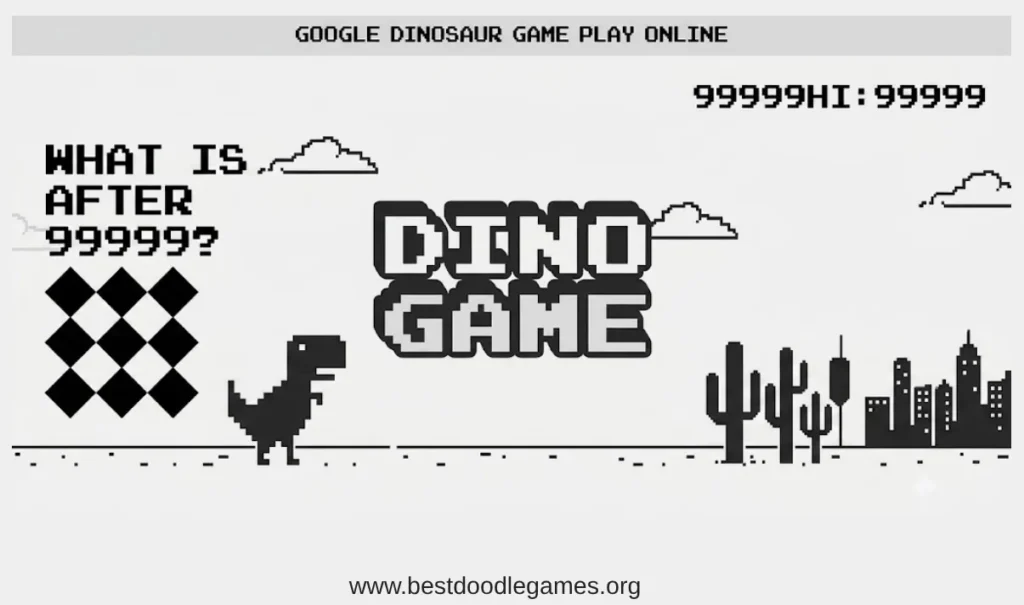
The Google Dinosaur Game, also known as Chrome Dino or T-Rex Runner, is an endless runner in which the dinosaur automatically moves forward. The player’s job is to keep it running for as long as possible by jumping over ground obstacles and avoiding flying ones.
The game was created as part of the Google Chrome experience for users who encountered an offline or no-internet error. Instead of simply showing an error message, Chrome offered a small playable experience. The concept was introduced in 2014, and the game has remained closely associated with Google Chrome ever since.
The main character is a T-Rex, while the environment uses a simple pixel-art desert design. As the run continues, the game becomes faster, requiring increasingly precise timing.
How to Start the Google Dinosaur Game
On desktop, the game can be started with the Spacebar. The Up Arrow can also be used for jumping during gameplay. On supported mobile versions, tapping the screen performs the main jump action.
The original Chrome experience is associated with the browser’s offline screen, while online versions allow the same style of gameplay to be accessed directly through a web browser. This makes the game easy to play without complicated controls, accounts, or lengthy instructions.
Google Dinosaur Game Controls
The controls are intentionally simple because the challenge comes from timing rather than complicated movement. On a desktop computer, pressing the Spacebar starts the run and makes the T-Rex jump. The Up Arrow provides another way to jump, while the Down Arrow makes the dinosaur duck.
A quick jump input can be useful when clearing a smaller obstacle, while holding the jump control can produce a longer jump in versions that support that behavior. On mobile devices, tapping the screen is generally used for jumping, and some versions support a downward swipe for ducking.
The R key is also used as a restart control on some online versions of the game.
Cacti and Flying Obstacles
Cacti are the main ground obstacles in the Google Dinosaur Game. They can appear in different arrangements, meaning the player cannot rely on exactly the same jump every time. Some versions describe 3 cactus patterns, including single, double, and triple cactus arrangements.
Flying obstacles, commonly represented by pterodactyls or birds, create another timing challenge. They require the player to understand whether jumping or ducking is the safer response. Some versions identify 3 flying heights, generally described as low, medium, and high.
One commonly reported gameplay milestone is 500 points, after which flying pterodactyls can begin appearing. This adds another layer of difficulty because the player must react to both ground-level and airborne obstacles.
How the Difficulty Changes
The T-Rex does not simply run at one fixed pace. The game gradually increases its speed as the player’s run continues. This means an obstacle that feels easy during the first part of a run can become much more difficult later.
The changing speed is one of the main reasons the game remains challenging despite having only a few controls. Success depends on recognizing obstacles quickly and pressing the correct control at the right moment rather than memorizing a complicated sequence.
The background can also shift from day to night as the run progresses. This visual change helps signal that the player has survived for a considerable distance while keeping the otherwise minimal game environment interesting.
Google Dinosaur Game Score
The score represents the player’s progress as the T-Rex continues running. It increases with distance, so surviving longer generally produces a higher score.
There are different score displays and limits across online versions of the Dinosaur Game. Several versions based on the original Chrome-style experience describe a 99,999 score limit, after which the score returns to 0. Other online versions display a maximum of 999,999 before resetting. Because these versions can implement scoring differently, the exact maximum should not be treated as identical across every Dinosaur Game website.
Some versions also provide a score notification or retro-style sound at every 100 points, giving players small milestones during a run.
Why 17 Million Years Is Associated With the Game
The Google Dinosaur Game has an unusual piece of trivia connected to its maximum theoretical running time. Some descriptions estimate that the T-Rex could theoretically continue for around 17 million years.
This number is a playful reference connected to the estimated period associated with the T-Rex rather than a normal gameplay target. In practical terms, players are far more likely to focus on improving their high score than attempting anything close to such an enormous duration.
The Story Behind Project Bolan
The Dinosaur Game also has an internal-history connection through the name Project Bolan. The name is associated with Marc Bolan, the musician and frontman of T. Rex.
The Chrome Dino project is commonly associated with members of the Chrome UX team, including Edward Jung, Sebastian Gabriel, and Alan Bettes. The game’s simple appearance was designed to fit the limitations and visual style of a small offline browser experience while still making the waiting period more entertaining.
How Long Can You Survive?
There is no traditional final level in the Google Dinosaur Game. It is designed as an endless runner, so the objective is to continue for as long as possible without hitting an obstacle.
This structure makes the game particularly suitable for high-score competition. A player can try to beat a previous result, challenge friends, or simply see how long they can maintain concentration as the dinosaur becomes faster.
The absence of a conventional ending is an important part of the experience. There is no final boss, story conclusion, or destination to reach. The run continues until the T-Rex collides with an obstacle or reaches a score limit implemented by that particular version.
Why the Google Dinosaur Game Is Still Popular
The game’s popularity comes largely from its simplicity. There are only a few basic controls, the objective can be understood immediately, and a new run can begin almost instantly. At the same time, increasing speed creates a natural difficulty curve that rewards concentration and practice.
Its 2014 origin also gives the game a recognizable place in Chrome history. What began as an offline browser experience became a widely recognized endless runner, with online versions adding features such as leaderboards, player statistics, different difficulty modes, mobile support, and alternative game variations.
Some fan-made versions offer 3 difficulty modes, commonly labeled Normal, Easy, and Hard. These additions extend the basic concept while keeping the central T-Rex running mechanic intact.
Google Dinosaur Game: Quick Facts
The Google Dinosaur Game was introduced in September 2014 as a Chrome offline experience. It uses a T-Rex as its main character and follows an endless-runner format. The primary desktop controls are the Spacebar, Up Arrow, and Down Arrow, while mobile versions commonly use tapping and, where supported, swiping.
The game features cacti and flying pterodactyls as obstacles, with some versions introducing flying obstacles after approximately 500 points. The scenery can change from day to night, and the running speed increases as the player survives longer. Depending on the version, score systems may use 99,999 or 999,999 as a displayed maximum. Some versions also mark every 100 points with a sound or visual milestone.
Frequently Asked Questions
When was the Google Dinosaur Game introduced?
The Google Dinosaur Game was introduced in September 2014 as an offline Chrome experience for users who encountered an internet connection error.
What are the main controls?
The main desktop controls are the Spacebar and Up Arrow for jumping and the Down Arrow for ducking. Mobile versions generally use a screen tap for jumping.
What obstacles appear in the game?
The main obstacles are ground-based cacti and flying pterodactyls or birds. Some versions describe 3 cactus patterns and 3 flying heights.
When do pterodactyls appear?
Several versions of the game describe pterodactyls appearing after the score passes approximately 500 points.
Does the Dinosaur Game have a final level?
No. It is an endless runner, so there is no conventional final level. The objective is to survive as long as possible and achieve a higher score.
Does the game get faster?
Yes. The T-Rex’s running speed increases as the run continues, making obstacle timing progressively more difficult.
Does the background change?
Yes. The game can transition from a day setting to a night setting as the run progresses.
What is the highest score?
The score limit depends on the version. Chrome-style versions are commonly described with a 99,999 limit, while some online versions use 999,999. Some versions reset the score to 0 after reaching their maximum.
What is Project Bolan?
Project Bolan is the internal name associated with the development of the Chrome Dinosaur Game. The name references Marc Bolan and his band T. Rex.
How long could the game theoretically run?
Some descriptions give a playful theoretical duration of around 17 million years. This is a trivia reference rather than a practical gameplay objective.
Final Thoughts
The Google Dinosaur Game proves that a browser game does not need complicated mechanics to be engaging. Since its introduction in 2014, the T-Rex runner has turned a simple offline moment into a fast reaction challenge involving cacti, flying obstacles, increasing speed, changing day-and-night scenery, and high-score competition. With controls as simple as the Spacebar, Arrow keys, or a mobile tap, almost anyone can understand it within seconds. The real challenge begins when the dinosaur gets faster and every jump requires better timing.